
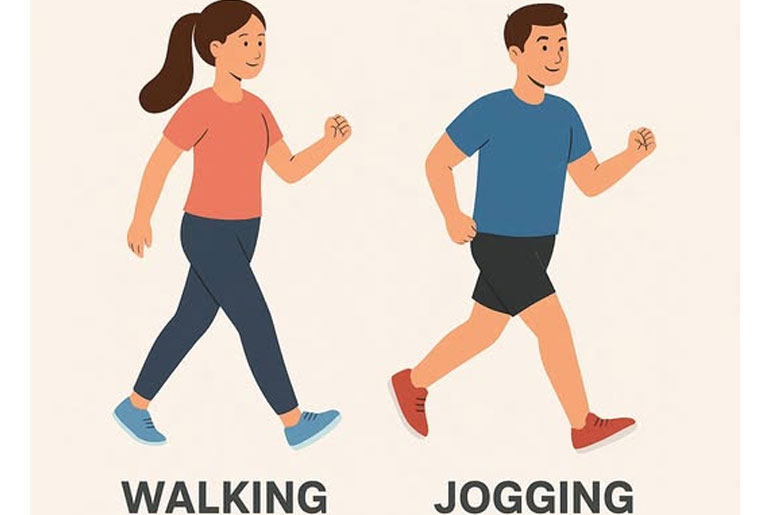
In this era of wellness-conscious individuals, everyone understands that walking enhances your health and quality of life. Walking enhances mental health by lowering stress, elevating mood, and enhancing cognitive function in addition to strengthening bones and muscles, boosting cardiovascular health, and helping with weight control.
However, many people frequently ask: Is a quick jog better for heart health? Or ought they to take a long, vigorous stroll?
This subject has long perplexed both novices and seasoned fitness enthusiasts, but that is no longer the case. Current scientific findings now support our response.

What the study concludes
According to new research, individuals who walk for 15 minutes or more each day had a considerably lower risk of heart disease and death than those who take many short walks throughout the day. In a study of more than 33,000 healthy adults (average age 62) who were watched for nearly ten years, the Annals of Internal Medicine found that those who took most of their steps in short walks of less than five minutes were much more likely to have heart problems. According to the research, the length of each walking session may have a greater impact on your style than the overall number of steps you take. The results are particularly significant for relatively inactive individuals.
Highlights of the study
Which aspects of the study stand out? To measure not only the number of steps taken but also how those steps were categorized into walking “bouts,” the international team of scientists used data from the UK Biobank, a sizable health research database in the UK, to examine 33,560 adults who, on average, recorded fewer than 8,000 steps per day. Participants wore wrist-worn accelerometers for three to seven days between 2013 and 2015.
The researchers divided the individuals into four groups based on the number of steps they took in a single walk:
- Under five minutes
- Five to ten minutes or less
- Ten to fifteen minutes or less
- 15 minutes or more
It’s fascinating to note that individuals who walked for the longest periods of time had the lowest risks of cardiovascular disease (CVD) and death after a follow-up period of roughly nine years. In the “less than 5-minute” group, for example, the all-cause death rate was approximately 4.36%, but in the “15-minute or longer” group, it was only approximately 0.80%. About 13.03% of the shortest-bout group had a higher risk of CVD than the longest-bout group, which had a risk of 4.39%. Furthermore, the advantages of lengthier walks were even greater for the most sedentary people (less than 5,000 steps per day).
From “number of steps” to “distance of my walk”
The study’s results indicate that the narrative has changed, and we now need to consider “how long did I walk at once?” rather than just “how many steps did I take today?”
But why is it beneficial for your health to walk for longer periods of time?
Let’s examine the important elements.
- Cardiovascular stimulation: Your heart rate remains high and your body undergoes prolonged aerobic exercise when you walk for ten to fifteen minutes straight. This promotes better oxygen delivery, blood flow, and heart muscle conditioning.
- Benefits to metabolism: Longer movement sessions may assist in stimulating lipid metabolism, insulin sensitivity, and other cardiometabolic pathways that may not be fully activated by shorter bursts.
- Less fragmentation results in greater impact: The body may not achieve an efficient constant state of activity when walking is divided into several brief bursts (e.g., 1-2 minutes here and there). The more consistent the effort, the greater the reward.
- Behavioral factors: Longer walks may promote the development of habits because they are typically more purposeful and may be taken at a somewhat faster or steadier pace. Setting aside 10 to 15 minutes on a regular basis can turn into a habit rather than an impulse.
- Feasibility: Aiming for “one block of 10-15 minutes walking” rather than numerous micro-walks may be simpler for those who are less active. In actuality, the least active group in the research had the largest benefits.
What does it mean for you?
The most significant improvements were observed in those who were initially less active; however, the benefits are generally applicable. Those who reduced their daily step count by switching from extremely brief to longer walking bursts showed the most significant risk reductions.
Consequently, the result implies:
Walking continuously for 10 to 15 minutes can potentially make a significant difference if you now walk infrequently or very little.
Compared to high-intensity workouts, this method is accessible, safe, and probably more maintainable if you’re older, work a sedentary job, or have restricted mobility.
You might want to think about splitting up your frequent short walks into longer sessions if you’re already active to possibly reap more benefits.
Note that this study has its set of limitations, too, including the fact that it is observational in nature and that, even though it accounts for many variables, it is unable to establish causation. This data suggests that walking more may also be a sign of other beneficial activities.
What to do: Doable strategies for walking more intelligently and for longer
When you can, plan a 10- to 15-minute walk for after meals, in the morning, or during a break.
If your fitness permits, try to walk steadily and consistently without stopping and starting.
If 10 to 15 minutes seems excessive at first, start with 5 to 8 minutes and work your way up to more than 10.
Be consistent; doing this on a regular basis (daily or most days) can help you transform a habit into a long-term benefit.
Take into account both the walking time and the speed. A moderate pace works best, but if it feels comfortable, you can pick it up a bit (a quick walk) for a greater impact.
Choose a safe route, wear comfortable shoes, and, if necessary, carry water or go for a walk during cooler hours.
Monitor your progress by keeping track of your continuous walk time instead of just your steps using a timer or a phone app.
However, before increasing the length or speed of your walks, speak with your healthcare professional if you have any health ailments, joint troubles, or mobility issues.
Disclaimer:
The information contained in this article is for educational and informational purposes only and is not intended as a health advice. We would ask you to consult a qualified professional or medical expert to gain additional knowledge before you choose to consume any product or perform any exercise.