
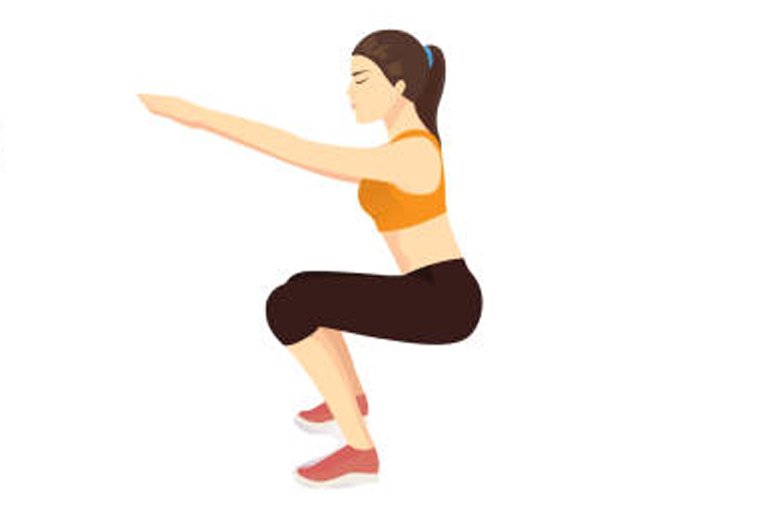
Unbelievably, the body could benefit from just five minutes of complete squats every day. Squats are a fundamental exercise that works several muscles and joints at once, according to studies. Because they call for synchronization between the hips, knees, ankles, and core, they are a functional workout that is closely related to daily activities like standing, climbing stairs, and carrying goods.
The proper way to squat
Stand with your feet slightly wider than your hips and your toes pointing slightly outward to perform a squat. Keep your shoulders back, your chest up, and your eyes forward. Bend your knees and keep your heels flat on the floor while you slowly push your hips backward as though you were sitting in a chair. Maintaining a straight back and a firm core, descend as far as you can comfortably until your thighs are nearly parallel to the floor. Squeeze your glutes at the peak and push through your heels to stand back up. Inhale as you descend, and exhale as you ascend. Make sure your back doesn’t round and that your knees and toes remain in alignment as you move slowly and deliberately.
What happens if you squat for five minutes every day?
Although exercise may seem easy, holding a squat for five minutes works almost all of your lower body’s key muscles and joints. Your quads, hamstrings, glutes, calves, and core muscles are all being worked during this static hold. Over time, maintaining a squat posture can yield several health benefits.

- It enhances the strength and tone of the lower body: Deep squats enhance strength and endurance by working the primary muscular groups, including the glutes, hamstrings, quadriceps, and calves. Participants who performed full-depth squats for 10 weeks experienced a substantial increase in muscle volume in their thighs and glutes when compared to those who performed half squats, according to a 2019 study published in the Journal of Strength and Conditioning Research.
- Increases the flexibility and mobility of joints: By stretching the hips, knees, and ankles, the squat position improves joint range of motion. Studies reveal a considerable correlation between squat depth and hip and ankle mobility. Frequent squats help combat the stiffness brought on by extended sitting.
- Squats strengthen the connective tissues and bones: In addition to strengthening muscles, squats also promote bone growth and tendon strength. Squatting exercises increase tendon stiffness and bone density, which may reduce the risk of injury and degenerative joint problems, according to an NIH narrative review.
- Improves body control, posture, and balance: Squats and holding exercises enhance proprioception, or the body’s awareness of its location and motion. This results in improved posture and coordination in day-to-day activities. Full-range squats produce better neuromuscular control and functional strength than partial squats, according to a 2019 study.
- Promotes intestinal health and digestion: Squatting naturally relaxes the pelvic floor and aligns the rectum, making bowel motions easier. According to a 2025 scoping review published in BMC, squatting positions for defecation resulted in faster elimination and less effort than sitting postures.
- Encourages both mobility and healthy aging: According to a 2021 study, home-based squat exercise enhanced the leg strength, walking ability, and general physical function of older individuals. In older populations, the ability to stand and squat independently is linked to a higher life expectancy.
Who should be cautious before performing squats?
Although most people find squats to be safe and useful, certain people should go cautiously or see a specialist before incorporating them into their program. Joint stress can result from improperly holding or doing squats, particularly deep or extended ones, if you already have a medical issue. People who have knee issues or previous injuries should exercise caution.
- Mobility problems in the hips or ankles Pain in the lower back or issues with the spine
- Neurological or balance problems Pregnancy or weakening of the pelvic floor
Disclaimer:
The information contained in this article is for educational and informational purposes only and is not intended as a health advice. We would ask you to consult a qualified professional or medical expert to gain additional knowledge before you choose to consume any product or perform any exercise.