

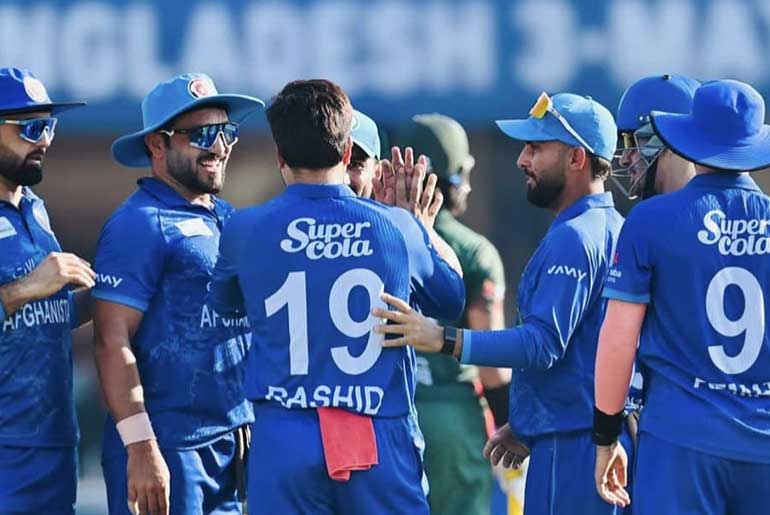
Just over a year after their remarkable journey to the semifinals of the ICC T20 World Cup last year, Afghanistan will begin their Asia Cup campaign as dark horse contenders against Hong Kong starting Tuesday in Abu Dhabi.
Afghanistan is among the fastest-growing cricketing nations in recent years, having defeated South Africa, England, Australia, Pakistan, and Sri Lanka in white-ball cricket. They established themselves as a formidable force in world cricket, particularly in T20Is, with their run to the quarterfinals of the T20 World Cup last year, which included victories against formidable opponents like Australia and New Zealand.After the T20 World Cup last year, let’s examine Afghanistan’s performance before the continental tournament:
Afghanistan has participated in eight Twenty20 Internationals since the T20 World Cup last year, winning five and losing three. Although they defeated Zimbabwe 2-1 on the road in December of last year to win the bilateral series, they just fell to Pakistan in the tri-nation series final in the United Arab Emirates. With three victories and two defeats, they concluded the tri-series.
Afghanistan’s advantages, mostly in bowling and playing time in the host area:
A powerful spin onslaught spearheaded by Rashid Khan: Afghanistan boasts a formidable spin attack under captain Rashid Khan, with a young left-arm wrist spinner named Noor Ahmed, a 19-year-old right-armer named Allah Ghazanfar, and a cunning 40-year-old right-armer named Mohammed Nabi. They may easily turn their opponents into a quick snack if the tracks in Dubai prove to be slow and offer turn. Rashid had been playing well in T20Is before the Asia Cup, taking nine wickets in four games at an average of 12.77 and an economy rate of 7.18, despite his recent sporadic difficulties.
Rashid has taken 47 wickets in 40 T20 matches this year alone, but his average of over 24 and economy rate of 8 indicate that he is a far more vulnerable bowler than he was previously, at least in franchise cricket. The Oval Invincibles won three titles in the United Kingdom thanks in large part to Rashid, who took 12 wickets at an average of 13.66 in six games during The Hundred.
Game time in the UAE: Afghanistan has played in the UAE for a while, but not at the Asia Cup venues of Dubai and Abu Dhabi, after finishing as finalists in the tri-nation series played in Sharjah. The Rashid-led team has had some success and has the advantage of having already played in the United Arab Emirates, even though the conditions at these two locations may differ. Conditions in Sharjah were quite spin-friendly, as evidenced by the fact that spinners dominated the top five in the wicket-takers list. Abu Dhabi and Dubai may experience similar conditions.
Ibrahim Zadran’s form: Since last year, Zadran has played in five Twenty20 Internationals, scoring 194 runs at an average of 38.80, two half-centuries, and a strike rate of 132.87. His highest score was 65.
Afghanistan’s disadvantages before the tournament:
Poor batting form: Rahmanullah Gurbaz, Afghanistan’s front-line batsman, is currently struggling for runs, scoring just 104 runs in eight appearances at an average of 15.50 and a strike rate of 104.20. This comes just after he finished as the top-run scorer in the T20 World Cup with 281 runs in eight games, including three fifties. Afghanistan’s batting is not in the best shape going into the tournament.
When taken as a whole, their strike rate of 117.07 is the second-lowest, with Oman trailing behind with a strike rate of 111.71, while their batting average of 20.96 is the third-lowest, behind Sri Lanka (20.88) and Pakistan (19.84). Afghanistan has the lowest strike rate in this year’s Asia Cup among all the Test-playing countries. Additionally, going into the competition, their batters had the fewest fifty-plus scores (no hundreds) of any team since the T20 World Cup 2024, with just six of them in 66 innings.
Lack of game time: Even non-Test playing nations like Oman (15), Hong Kong (27) and the United Arab Emirates (29) have significantly superior game time and preparation than Afghanistan, which has played the fewest T20Is of any participant going into the Asia Cup with eight. Although Afghans play a significant role in T20 leagues around the world, which is undoubtedly a bonus, the competition’s intensity and stakes are not as great as those of this prized continental event.
Rahmanullah Gurbaz, Ibrahim Zadran, Darwish Rasooli, Sediqullah Atal, Azmatullah Omarzai, Karim Janat, Mohammad Nabi, Gulbadin Naib, Sharafuddin Ashraf, Mohammad Ishaq, Mujeeb Ur Rahman, Allah Ghazanfar, Noor Ahmad, Farid Malik, Naveen-ul-Haq, and Fazalhaq Farooqi are the Afghanistan team for the Asia Cup.
Disclaimer:
The information contained in this article is for educational and informational purposes only and is not intended as a health advice. We would ask you to consult a qualified professional or medical expert to gain additional knowledge before you choose to consume any product or perform any exercise.