
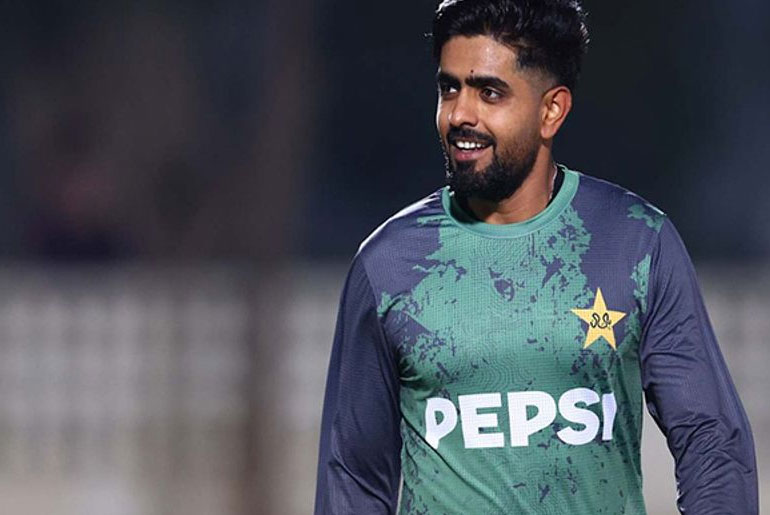
Coach Mike Hesson of Pakistan said that 30-year-old star batsman Babar Azam was “working really hard on” his game against spin and strike rate in order to make a comeback to the T20I setup.
Babar hasn’t played for Pakistan in the shortest format since the end of the previous season, and the right-hander was recently left off of the team’s roster for the Asia Cup next month as well as the tri-series against Afghanistan and the United Arab Emirates.
When the former captain of Pakistan scored 47 off 64 deliveries in the first game of Pakistan’s recent ODI series against the West Indies in Trinidad, he appeared to be in good form. However, selectors were not impressed by his two subsequent failures (zero and nine) in the series.
He was heavily criticized for his overall strike rates of 129.22 and 133.21 in 24 games and 23 innings last year, while he amassed 738 runs with six fifties.
Hesson left the door open should the former captain of Pakistan do well in Australia’s domestic Big Bash (BBL) competition in December and January. He also identified two crucial areas that Babar needs to improve if he wants to rejoin the national team for the upcoming T20 World Cup at the beginning of next year.
“There is no doubt Babar’s been asked to improve in some areas around taking on spin and in terms of his strike rate. Those are things he is working really hard on,” Hesson stated as quoted by ICC.
“But at the moment the players we have, have done exceptionally well. Sahibzada Farhan has played six games (against Bangladesh and West Indies) and won three Player of the Match awards.”
“A player like Babar has an opportunity to play in the BBL and show he is improving in those areas in T20s. He is too good a player not to consider,” he attached.
Selectors chose to include hitters who often scored at a high strike rate, therefore Mohammad Rizwan was left out of Hesson’s team of 17 players for Pakistan’s forthcoming matches, making Babar’s omission not the only surprise.
Hesson noted that selecting batters who scored runs fast would be a part of his selection process moving forward and that it was crucial to reward players who had performed well in previous white-ball games.
“We were challenged with three different surfaces (in recent matches against Bangladesh and West Indies)” Hesson stated.
“In Lahore, the surfaces were flat and the batting excelled. We went to Bangladesh, where they were incredibly challenging and low-scoring games. Our top-order sets the game up. All the games we won the top order performed really well.”
“The third game in the West Indies, our openers put on 140 (138). We need a run rate that puts us ahead of the game. T20 is all about setting the game up and being ahead of the game all the time in case you get yourself out. From a batting point of view, we have got a line-up that can continue to do that,” he attached.
The Asia Cup will begin on September 9 and Pakistan’s campaign will begin on September 12 against Oman, followed on September 14 by a high-profile matchup with bitter rivals India.
Salman Ali Agha (c), Abrar Ahmed, Faheem Ashraf, Fakhar Zaman, Haris Rauf, Hasan Ali, Hasan Nawaz, Hussain Talat, Khushdil Shah, Mohammad Haris, Mohammad Nawaz, Mohammad Waseem Jr., Sahibzada Farhan, Saim Ayub, Salman Mirza, Shaheen Shah Afridi, and Sufyan Moqim are members of the Pakistani team for the Asia Cup and tri-series.
Disclaimer:
The information contained in this article is for educational and informational purposes only and is not intended as a health advice. We would ask you to consult a qualified professional or medical expert to gain additional knowledge before you choose to consume any product or perform any exercise.