
It can seem nearly impossible to find time for exercise in today’s hectic workplace, where long desk hours are the standard and screen time is still king. Nevertheless, accumulating evidence indicates that it’s essential to both stay healthy and guard against fatal illnesses.
Long periods of sitting are not only uncomfortable, but they can also be fatal, according to recent research. Those who sit for eight or more hours a day and exercise little or not at all have a markedly increased risk of developing cardiovascular disease, diabetes, and dying young. Long, uninterrupted periods of sitting can cause harm that cannot be completely reversed, even by people who reach the weekly physical activity goals that are advised.
Just think of how difficult it must be for someone who works a desk job to balance meetings and deadlines while hardly finding time to get home and relax!

You can protect yourself without changing your employment or adopting a rigorous exercise regimen. Short exercise bursts and easy “mini-movements” can have a significant impact during the workday. Furthermore, it is quite beneficial to intersperse periods of sitting with brief bursts of movement. As a matter of fact, studies have demonstrated that even brief exercise regimens at work can enhance cardiovascular fitness, muscle performance, and body fat percentages and lower the chance of an injury.
Walking quickly (or pacing when on calls)
Probably the easiest and most underutilized method of adding activity is walking. Imagine achieving the desired results without having to shell out a lot of money for a gym subscription! Start by taking phone calls while pacing, using a separate restroom, or opting for stairs rather than elevators to fit in quick walks into your hectic schedule. The crucial thing here is to get out of your chair. Simply standing up or changing rooms between breaks is beneficial to one’s health. A short, vigorous stroll of five to ten minutes can disrupt the sedentary habit, increase blood flow, and elevate mood.
Push-ups at the desk and standing
Posture and circulation are hampered by spending the entire day stuck to your workstation. Changing your workplace to a standing or semi-standing position (for a portion of the day) and adding quick strength exercises is one efficient solution. Put your hands on your desk, walk your feet back until your body is at an elevation, then bend your elbows to lower your chest and push up. This is similar to doing push-ups against a desk edge. After a meeting or when you feel stiff, perform 8–12 repetitions. This exercise breaks up the monotony of sitting, works the upper body, and activates the core.
Chair stands or bodyweight squats
You’re wrong if you believed that squats were simply beneficial for strengthening your lower body; they also assist in counteracting prolonged sitting. Try doing 10–15 body-weight squats every hour, or stand up and sit down from your chair 12–20 times. These easy repetitions add up. For instance, you could complete 48 body-weight squats in an eight-hour workday if you performed 12 squats every two hours. Consistency, not intensity, is the key.
Resistance-band rows or shoulder presses performed at a desk
Say it again for us: You don’t have to wait till after work to undertake strength training. Store a light resistance band beneath your desk or in a drawer. Spend a minute performing 10 rows (with the band secured under the desk or around the leg of a chair) and 10 shoulder presses (either standing or sitting) every hour or so. These exercises work the shoulder and upper back muscles, which can become weak or tense from bending forward when using screens. Even simple strength and balance exercises are beneficial for sedentary workers, according to the AHA.
Ankle rolls and calf raises (to improve circulation)
Experiencing cramps too frequently? Long-term sitting decreases blood flow to the lower legs, which can cause stiffness, edema, or even excruciating cramps. To combat this, perform 15–20 calf raises every 30 to 60 minutes. To do this, stand behind your chair, raise your heels, and then slowly drop yourself to your toes. Then, while seated, perform a few ankle rolls in both clockwise and counterclockwise directions. These mild exercises increase blood flow, lessen exhaustion, and increase alertness.
Mobility and stretching breaks
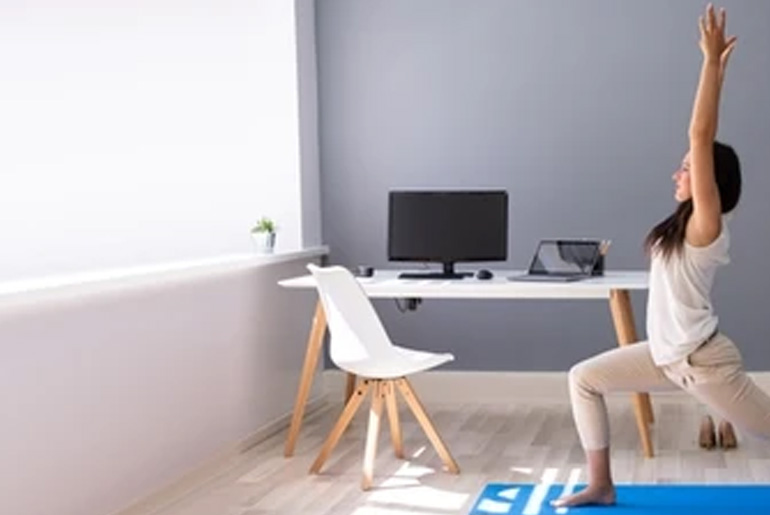
Stretching frequently is crucial when you spend your entire day in “sit mode,” so it’s not only for the aesthetics of social media. A timer should be set for each hour. Stretch your arms overhead, rotate your shoulders back and down, spin gently out of your chair, and open your chest for one to two minutes after it stops. These brief movement breaks relieve neck discomfort, upper-back hunched posture, and tight hips caused by screen time. Research indicates that workplace physical exercise lowers workplace injuries while also improving quality of life.
Short bursts of high intensity (if you have two to three minutes)
Try a quick burst of high intensity, such as 30 seconds of jumping jacks or stair climbing, followed by 30 seconds of rest, repeated two or three times, if you have very little time but still want to increase your productivity. Keep in mind that even brief, high-intensity exercise can boost busy adults’ energy levels, mood, and metabolic health. Use them to boost your energy levels before a demanding meeting or when you’re feeling down in the middle of the afternoon.
Disclaimer:
The information contained in this article is for educational and informational purposes only and is not intended as a health advice. We would ask you to consult a qualified professional or medical expert to gain additional knowledge before you choose to consume any product or perform any exercise.