
Everybody is buzzing about yoga! You might start doing yoga because you want to get healthier or because your favorite celebrity does. Whatever the motivation, it is an age-old technique that fosters strength, flexibility, and mindfulness. You can utilize props for different asanas if the poses are difficult for you. Beginner yoga blocks are one such prop. These can help you improve your technique. Rectangular aids composed of wood, foam, or cork will reduce the chance of harm and aid in correct alignment. During your yoga sessions, these props can help with balance, stability, and support.
What are the advantages of yoga blocks for novices?
The body can be supported while doing the poses with the help of props like yoga blocks. According to a 2021 study published in Alternative Therapies In Health And Medicine, they can assist people in striking positions that would otherwise be more challenging. The following are some advantages of yoga blocks for novices:
1. Increases adaptability

Beginner-friendly yoga blocks are ideal for increasing flexibility. They can assist you in experimenting with more complex variations of your stances. “Yoga blocks for beginners can make stretches more achievable by offering support, which over time can result in noticeable increases in flexibility,” explains yoga instructor Fenil Purohit.
2. Aids in focusing on particular muscle groups
For novices, use yoga blocks, which can help isolate specific muscle groups. “In Sahayak Setu Bandhasana or Supported Bridge Pose, for example, placing one of the colorful blocks beneath your sacrum can help open up your chest and shoulders while engaging your hip flexors,” the expert explains.
3. Improves stability and alignment
When performing any yoga posture, it’s critical to maintain appropriate alignment. Beginners can benefit from using yoga blocks to help them find and maintain proper alignment. According to the expert, “this in turn enhances stability and minimizes the risk of injury.”
4. Could lessen back discomfort
It should come as no surprise that many of us suffer from back discomfort given our sedentary jobs. According to a 2023 study that was published in the Journal of Clinical Medicine, up to 84% of people would experience lower back pain at some point in their lives. “Using beginner yoga blocks in seated or restorative poses can help reduce back pain and promote proper spinal alignment,” the expert explains.
5. Could ease hip tightness
Long periods of sitting might result in hip stiffness in addition to back pain. One of the primary causes of hip stiffness and pain, according to a 2021 study published in Musculoskeletal Science And Practice, is prolonged sitting. Beginners should use yoga blocks because they work well for releasing tension in particular places, such as the hip. According to Purohit, “using blocks can facilitate their release as hips frequently experience stiffness.”
How can beginners use yoga blocks?
Here are a few beginner-friendly poses that use yoga blocks:
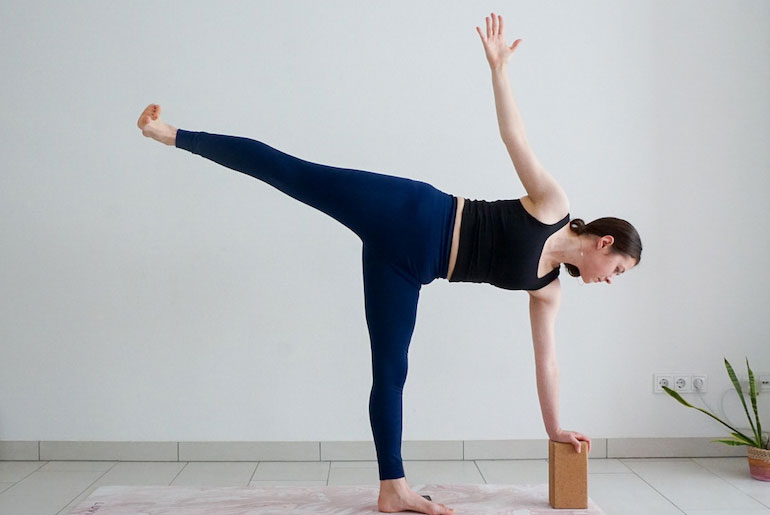
1. Triangle Pose (Trikonasana):
- Turn your right foot outward while standing with your feet wide apart.
- Your arms should be extended parallel to the floor.
- Reach your right hand toward the floor while bending at the waist.
- For extra support, place a beginner’s yoga block under your right hand.
- Lift your left arm and give the ceiling a glance.
- After about 30 seconds of holding this position, switch sides.
2. Crow Pose (Kakasana):
- Lower your body into a squat while placing two yoga blocks beneath your feet.
- Put your hands shoulder-width apart on the mat.
- Raise your hips a little while using your core.
- Lift your feet off the blocks and shift your weight forward.
- With your knees resting on your upper arms, maintain your balance on your hands.
- For 15 to 30 seconds, hold the position.
3. Bound Angle Pose (Baddha Konasana):
- Bring the soles of your feet together while sitting on the mat in the Bound Angle Pose (Baddha Konasana).
- Let your knees drop open on their own.
- For support, place a block beneath each knee.
- Relax your shoulders and maintain a straight spine.
- For one to two minutes, hold the stance.
4. Plank Pose (Phalakasana):
- Place two blocks shoulder-width apart beneath your hands to perform the Plank Pose.
- To make a straight line from your head to your heels, take a step back with your feet.
- Keep your arms outstretched and engage your core muscles.
- For 30 seconds, hold the pose, making sure your breathing is steady throughout the pose.
5. Wheel Pose (Chakrasana):
- Place your feet hip-width apart and lie on your back with your knees bent.
- Before raising into the posture, place a block under one hand.
- To raise your body into an arch, apply pressure through your hands and feet.
- Maintain an open chest and straight elbows.
- After ten to twenty seconds of holding the position, slowly lower yourself back down.
6. Utkatasana, or Chair Pose:
- Place your feet hip-width apart.
- Between your thighs, place a yoga block.
- Lower yourself into a squat by bending your knees.
- Keep your arms outstretched overhead and your chest high.
- Squeeze the block gently, then hold it for 30 seconds.
7. Fish Pose (Matsyasana):
- Place a block beneath your upper back while lying on your back.
- Lengthen your neck and let your head lay back.
- Stretch your legs and arms out.
- For 30 seconds, maintain this posture while taking deep breaths.
8. Pigeon Pose (Eka Pada Rajakapotasana):
- For this pose, begin with your right knee forward in a low lunge.
- Move your right shin in the direction of the mat’s front edge.
- For extra support, place a block under your back thigh.
- Keep your chest up high and concentrate on taking deep breaths.
- After 30 seconds of holding the position, move to the other side.
9. Low Lunge (Anjaneyasana):
- Take a lunge position by stepping forward with your right foot.
- For support, place a block under your left thigh.
- Maintain your hands on your knees or raise them above your head.
- After 30 seconds of holding the position, switch sides.
- 10. Adho Mukha Svanasana, or the downward-facing dog
- Place two blocks at the lowest setting beneath your hands.
- As you return to Downward Dog, raise your hips.
- Make sure your heels are pressed down and your spine is extended.
- For 30 seconds, hold the stance while taking deep breaths.
11. Cobra Pose (Bhujangasana):
- To accomplish this pose, extend your legs and lie face down.
- Place two blocks under your palms.
- To raise your chest, press into the beginner’s yoga blocks.
- Maintain a comfortable posture with your shoulders and elbows slightly bent.
- For 20 to 30 seconds, hold the stance.
12. Start in Boat Pose (Navasana)
- By sitting on the mat with your feet flat and your knees bent.
- A block should be positioned between your thighs.
- To form a V, gently raise your legs and lean back.
- Keep your back straight and use your core muscles.
- Hold the position for 20 to 30 seconds.
- Beginner-friendly yoga blocks can revolutionize your practice. Even though these are only basic tools, they can help with alignment, comfort, and flexibility.
Disclaimer:
The information contained in this article is for educational and informational purposes only and is not intended as a health advice. We would ask you to consult a qualified professional or medical expert to gain additional knowledge before you choose to consume any product or perform any exercise.