
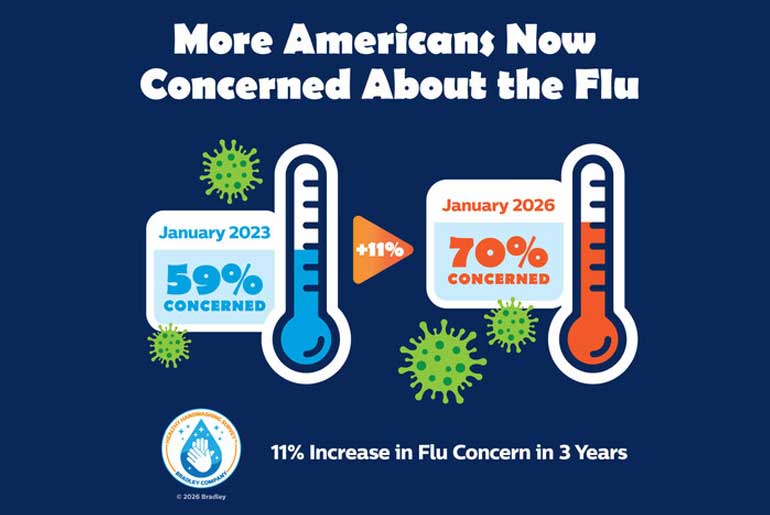
Americans are becoming much more worried about becoming sick as the country is experiencing a severe flu season. The 2026 Healthy Handwashing Survey™ found that 70% of Americans are very or somewhat afraid about getting the flu, up from 59% three years ago.
More careful hand hygiene is a result of this growing concern. According to the survey, 81% of Americans say they wash their hands more often or thoroughly during seasonal viral surges and flu outbreaks, up from 74% in 2023. The fact that almost all respondents (93%) think handwashing is crucial to preserving general health supports its status as one of the most reliable and easily available strategies to lessen the spread of disease.
Amidst the H1N1 virus, commonly referred to as the swine flu, Bradley, a manufacturer of commercial restroom equipment, conducted its inaugural Healthy Handwashing Survey in 2009. Only 45% of Americans at the time reported improving their hand cleanliness in reaction to seasonal viral epidemics. After 17 years, handwashing has become a popular method of preventing illness.

“Handwashing, using soap and warm water, is one of the simplest and most effective ways to reduce the spread of disease, including the flu,” stated Brian M. Forster, Ph.D., microbiologist and chemical hygiene officer at Saint Joseph’s University. “Our hands touch many surfaces during the day, including our face, and are an easy way for us to pick up something that can make us sick.”
According to the report, the most common reasons people wash their hands are coughing, sneezing, or being around sick people. Americans are more inclined to stay at home when they are sick, wash their hands more often, and drink more water.
Cutting Corners on Hand Hygiene
Although many people are aware of the health advantages of handwashing, the poll shows that these practices frequently fail, particularly in public facilities, underscoring the widening gap between awareness and everyday behavior.
Eighty-one percent of Americans reported washing their hands after using a public restroom last year. By 2026, that percentage had fallen to 76%.
Although frequency varies greatly, Americans report washing their hands eight times a day on average. A long-standing trend that highlights the disconnect between knowledge and routine is that women wash their hands roughly twice as frequently as males do.
Skipping the Suds—Even in Public Restrooms
Handwashing noncompliance in public facilities is still a noticeable and concerning issue. Compared to 68% in 2024, 77% of Americans report having witnessed someone leave a public restroom without washing their hands. However, one in five acknowledge that when no one else is around, they are more prone to neglect handwashing, highlighting the need for social accountability in maintaining hygiene.
Although the ideal way to wash hands is to lather up with soap and water, 44% of Americans confess to simply rinsing with water. Compared to women, men are more likely to forego soap (50% vs. 38%).
“For many people, the decision to wash their hands in a public restroom is influenced by the environment,” stated Jon Dommisse, vice president of business development and strategy for Bradley Company. “If a restroom appears poorly maintained or understocked, it can discourage proper handwashing—at exactly the moment when it matters most for public health.”
Despite Americans’ recognition of the importance of handwashing and their prompt action during high flu activity, maintaining these behaviors, especially in public places, continues to be challenging. One of the best strategies to help stop the transmission of colds, flu, and other infectious diseases is to wash your hands often and thoroughly throughout the day, not just during outbreaks, according to health experts.
Between January 5 and 16, 2026, 1,020 American adults participated in Bradley’s annual Healthy Handwashing Survey, which asked them about their handwashing practices, concerns about seasonal infections, and use of public bathrooms. A fairly equal number of men (44%) and women (55%) made up the participants, who came from all around the nation; 1% chose others.
Disclaimer:
The information contained in this article is for educational and informational purposes only and is not intended as a health advice. We would ask you to consult a qualified professional or medical expert to gain additional knowledge before you choose to consume any product or perform any exercise.