
Hip strength shapes the way the body moves in daily life. Strong hips support the lower back, enhance balance, stabilize each step, and facilitate basic activities like sitting for extended periods of time, standing up, and ascending stairs. Contrary to popular belief, hip training does not require complicated gym regimens. Long-term joint protection can be achieved by making little, deliberate movements that strengthen the hip-circling muscles. These six exercises combine ease, purpose, and a little everyday comfort.
Sidestep grips that help the hips remain steady
Holding each stride for three slow seconds increases the effectiveness of a basic sidestep. The outer hip muscles must exert more effort and maintain stability throughout the pause. Good control is developed by taking ten steps in each direction. This little exercise can be beneficial for those who experience knee wobbling when walking or using stairs.

Bridges on the floor with a light heel push
When the heels lightly press into the floor, the traditional bridge transforms into a more powerful action. This technique works both the hamstrings and the gluteus maximus. For a slow count of four, raise your hips, then drop them for another four. For novices, two sets of 12 repetitions are sufficient. This exercise helps relieve the stiffness caused by prolonged sitting and supports the lower back.
Hip raises while standing with fingertip balance
A controlled lift is more effective than complete leg swinging. Raise one leg out by only 20 to 30 degrees, stand tall, and lightly touch a wall with two fingers. Slow motion without allowing the torso to tilt is crucial. Strengthening the hip abductors, which are crucial for balance during fast turns or on uneven surfaces, requires ten raises per side.
The “step and sink” technique for powerful glutes
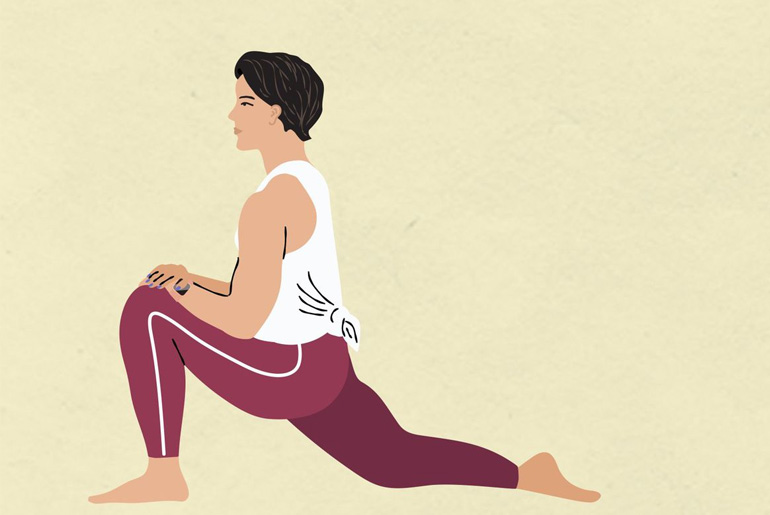
This motion appears to be a half lunge. Push back to the beginning after taking a step forward and sinking a little. The restricted depth increases hip engagement while protecting the knees. For each leg, perform 8–10 repetitions. After incorporating this pattern into their daily routine, those who walk long distances or carry bags on a daily basis report feeling more supported in their hips.
To relieve tight rotators, do a seated figure-four press
Sit up straight and cross one ankle over the other knee. Use a gentle palm to press the crossed knee downward rather than bending forward. After 20 seconds of holding, switch sides. This light pressure releases the piriformis, one of the deep hip rotators that frequently becomes stiff after prolonged sitting. During strength training, increased mobility enables more effective hip function.
Wall-supported single legs demonstrate real-life balance
Real-world hip strength is evident on one leg. For 20 to 30 seconds, raise one foot a few inches while standing close to a wall. The standing leg’s hip should remain level and stable. Flip sides. A wall support helps the hips learn to balance the body and eliminates the fear of falling. When performing abrupt motions, such as climbing buses or stepping over puddles, this easy exercise helps to relieve strain.
Disclaimer:
The information contained in this article is for educational and informational purposes only and is not intended as a health advice. We would ask you to consult a qualified professional or medical expert to gain additional knowledge before you choose to consume any product or perform any exercise.