
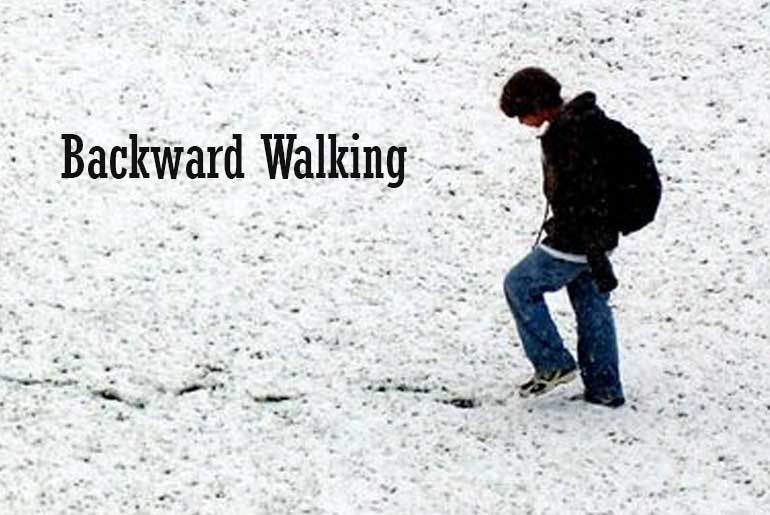
A well-known study examined the metabolic reactions to forward and backward walking. A few minutes of daily reverse steps can have unexpected advantages if you’ve ever felt that your regular walks have reached a plateau. Putting one foot behind the other can test the body and brain in unexpected ways, according to new research, so it’s not simply hype or a gimmick.
- Prioritize safety: Practice walking backwards securely.
Walking backward can be quite helpful, but it’s important to stay careful.
- Begin briefly and slowly: Start by simply walking backward in a level, safe, and obstacle-free area.
- Use support: Walk in a hallway with a wall or use a treadmill if one is available.
- Examine your path: When you’re strolling outside, pick a path you know well and steer clear of obstructions.
- Obtain expert advice: See a healthcare professional first if you are recuperating from an injury, have prior joint difficulties, or have balance issues.
More calories are burned than when walking ahead
A well-known study examined the metabolic reactions to forward and backward walking. The steps are more efficient since backward walking requires a lot more work than forward walking at comparable rates, according to the study. Research shows that walking backwards raises heart rate and oxygen consumption (VO₂), which means your body has to work harder to cover the same distance.

Retro, or backward, walking increases energy expenditure without lengthening the workout, according to an MDPI study done on obese adults. The finding implies that walking backward for even a short while can help burn additional calories, adding value to your daily steps.
Builds up underutilized muscles
The Indian Journal of Medical Research states that walking backwards lessens the strain on the knees and joints and more effectively uses muscles like the quadriceps, hamstrings, and glutes than walking forward, which helps improve lower body strength and balance.
This implies that walking in the style of the past can provide a more well-rounded workout.
Increases cardiovascular exertion
Walking backward challenges the heart and lungs in addition to working the muscles in a different way. Compared to forward walking at the same pace, studies reveal that retro walking increases heart rate and oxygen consumption more, indicating that the cardiovascular system receives a more strenuous workout in the same period of time.
After practicing backward walking for a few weeks, participants in clinical studies showed increased endurance and cardiorespiratory fitness.
Enhances stability, coordination, and balance
Six weeks of backward walking training greatly improved both dynamic and semi-dynamic balance, according to a study involving teenage athletes.
The body is put through more physical strain when walking backwards than when walking forward. According to an NIH study, it is particularly beneficial for older individuals and those recuperating from injuries in terms of rehabilitation and fall prevention.
Enhances stability, coordination, and balance
Six weeks of backward walking training greatly improved both dynamic and semi-dynamic balance, according to a study involving teenage athletes.
Walking backwards puts the body under more physical strain than walking forwards. According to an NIH study, it is particularly beneficial for older individuals and those recuperating from injuries in terms of rehabilitation and fall prevention.
Combining forward walking and backward walking
You can obtain the advantages without completely switching to backward steps. There is scientific evidence that walking forward and backward in turns can improve gait performance, balance, and function. Backward walking therapy greatly increased walking speed and balance more than forward walking training alone, according to a 2023 comprehensive review and meta-analysis of children with cerebral palsy. It is therefore both neurologically and biomechanically efficient to alternate between the two.
Disclaimer:
The information contained in this article is for educational and informational purposes only and is not intended as a health advice. We would ask you to consult a qualified professional or medical expert to gain additional knowledge before you choose to consume any product or perform any exercise.