

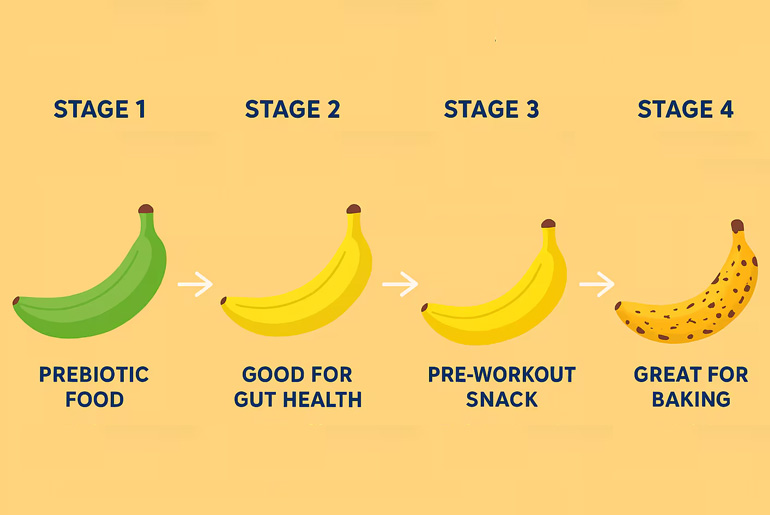
Because they are quick, easy, and nutrient-dense, bananas are among the most popular fruits consumed worldwide. It may surprise you to learn that as they ripen, their nutritional content and health advantages actually vary. With varying amounts of fiber, carbohydrates, vitamins, and antioxidants, each stage of ripeness—from solid green to soft, speckled brown—affects your energy levels, digestion, and even blood sugar balance.
This form is the healthiest way to consume bananas, as it promotes intestinal health and helps keep blood sugar levels in check. The doctor breaks down the four stages of banana ripening, from unripe to completely ripe. She explains how the fruit’s nutritional makeup changes with each stage and the health advantages that each one provides.
First stage: green bananas

Green or unripe bananas are rich in prebiotics, which support the health of your gut flora. “It has a lot of resistant starch, which is a prebiotic that feeds beneficial gut bacteria,” he says. Only 10 grams of sugar and roughly 3.5 grams of fiber per 100 grams.
Stage 2: Bananas that are a little green
When bananas are still slightly green, they are the healthiest to eat because they support balanced blood sugar levels and improved intestinal health. He says that there are “about two and a half grams of fiber per 100 grams, with potassium increasing and starch breaking down.”
Stage 3: Bananas are completely yellow
The physician claims that while fully ripe yellow bananas have higher vitamin and antioxidant content, they may have less resistant starch. “Fully yellow (bananas are) richer in antioxidants, vitamin C, and vitamin B5, but lower in resistant starch,” he explains. It is a fantastic pre-workout snack and is easy to digest.
Stage 4: Bananas with brown spots
Bananas are wonderful for smoothies and baking during the latter stage of ripening because of their inherent sweetness and tender texture, which go well with recipes like banana bread. It’s the sweetest, with almost 17 grams of sugar per 100 grams, he emphasizes. While fiber somewhat declines, antioxidant levels rise.
In conclusion, as bananas ripen, their nutritional value changes, making them adaptable to various culinary and health applications. Green bananas are packed with resistant starch that supports gut health; slightly green bananas offer the best balance for blood sugar control and digestion; fully yellow bananas provide higher vitamins and antioxidants, ideal for quick energy or pre-workout fuel; and bananas with brown spots deliver natural sweetness and boosted antioxidants, perfect for smoothies or baking. Depending on your objectives, you can optimize flavor and health advantages by selecting the appropriate stage.
Disclaimer:
The information contained in this article is for educational and informational purposes only and is not intended as a health advice. We would ask you to consult a qualified professional or medical expert to gain additional knowledge before you choose to consume any product or perform any exercise.